There is no more relaxing way to spend your vacation time than sketching, and your family might want to join in too, as mine did this last family vacation I took, in the Greek islands. What more could you ask than spending that kind of special quality time with your family?
Does this sound enticing? Join my once-monthly sketching classes, starting online 14th September at 5.00pm GMT+1. I am running an “explainer” session tomorrow, Monday 7th September, at the same time, completely free for everyone, whether you decide to sign up or not. If you would like to join us, send me an email to sketchwithroisin@gmail.com with “explainer” in the subject line and I will do the rest.
Friday 7th August
I am sitting in a bar near the port of Mastichari, on the island of Kos, in the Greek Dodecanese Islands. It’s about 11.30pm, we’ve just arrived on the late flight from the airport and I am enjoying an Aperol spritz with my family. We are soaking in the delicious feeling of a week’s holiday stretching ahead of us.
Since 2022 when we took our first island holiday as a family of five, we’ve visited a few islands in the Mediterranean: Menorca, Crete, Gozo. This is the first time our family has been split up on a summer holiday. Our eldest is at home with her boyfriend, recovering from an illness, and Reuben the terrier is behind bars, in a kennel, for the first time ever.
Saturday 8th August
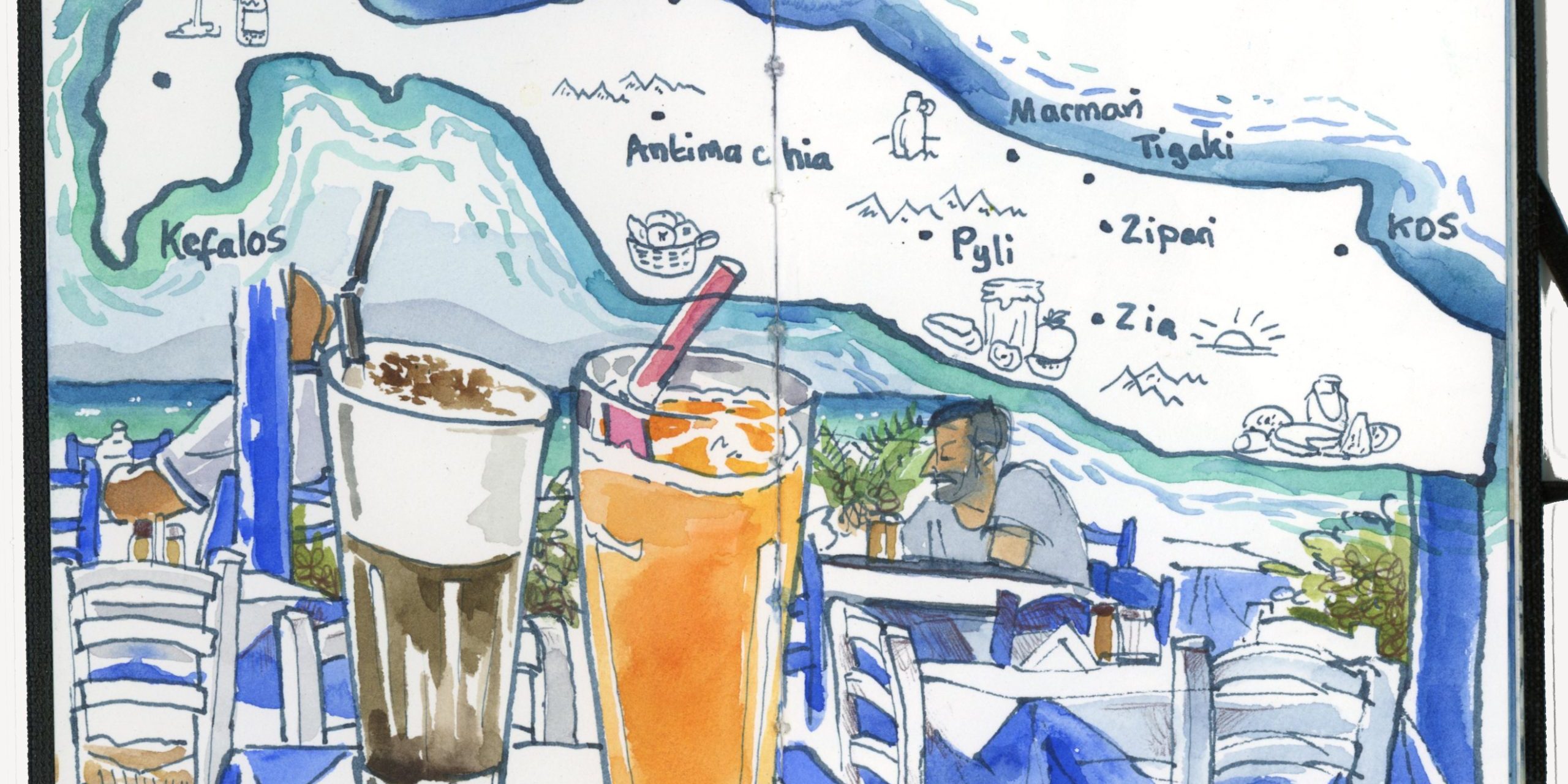
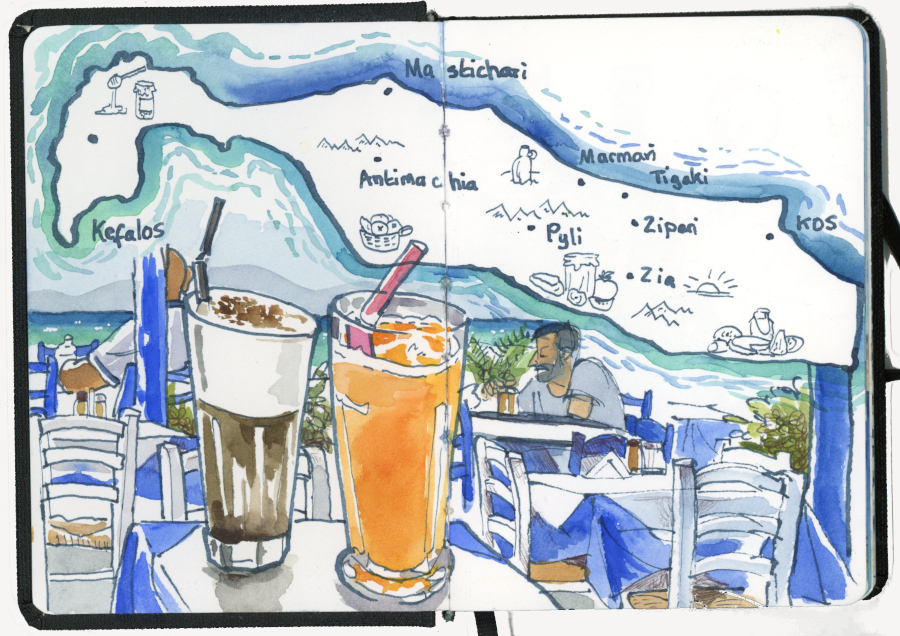
The following morning we make our way to the ferry port, a long concrete quay with one little boat waiting for passengers. We have a few minutes to wait for the ferry to Kalymnos, so we order refreshments at a taverna next to the quay. My adult children Olivia and Paddy, 22 and 24 respectively, are keen to start the sketching they’re determined to do on this holiday, and start to draw the map on the tablecloth. I join in in my sketchbook, but the map I draw looks a bit bald in pen, so I add the glass of freshly-squeezed orange juice and Paddy’s iced latte. I don’t add the background – that happens at the other end of the holiday, when we’re back in the same retaurant.
The waiter, a wiry man in his fifties, bald and bronzed with a lined and bony face, is warm and friendly, and his young underling is too. They are both enchanted to see us sketching.
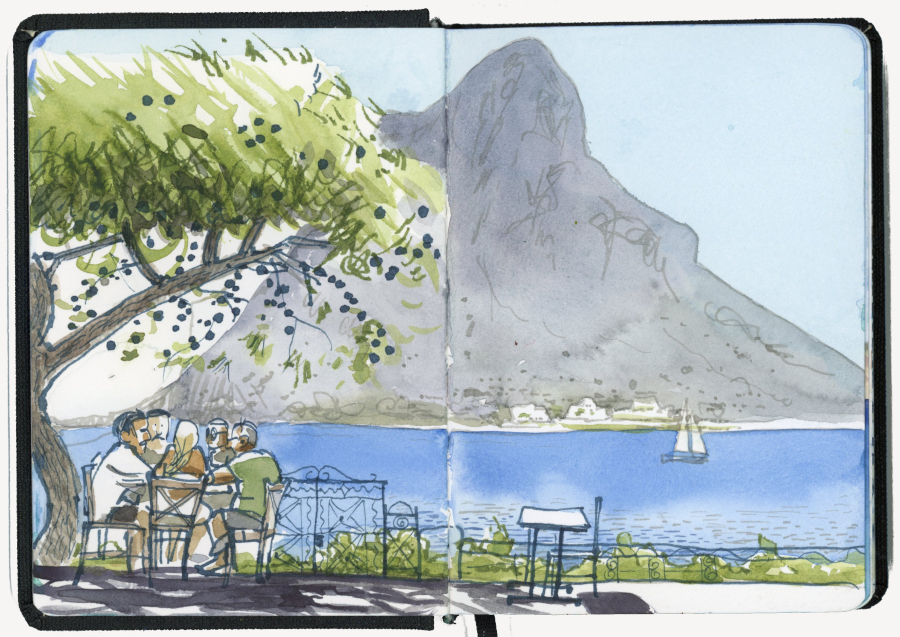
The ferry whisks us across the bay to Kalymnos, a ride of about thirty minutes. We take a taxi from the main port, Pothia, to our hotel in Massouri. The island is all mountain, and the vista of Massouri and its island across the bay stretching out before us takes our breath away.
The taxi driver, a fat older gentleman in late middle age, tells us about other Greek islands, and shares his horror for one island in particular.
“Take Mykonos, for example,” he says. “One lunch on the beach with calamari. How much? Seven hundred euros! Two sunbeds with cocktails – how much? Four hundred euros! And in the clubs, men – they kiss! Two men together!” I reflect on how difficult it must be to be gay in these parts…unless you’re in Mykonos, I guess.
We settle in, then go and eat at one of the roadside restaurants of Massouri, and the proprietor is very friendly. He is tall and beefy, with skin the colour of concentrated burnt sienna. He has huge brown eyes with dark circles underneath, grizzly hair in a man-bun / frizzy plait thing: he looks kind of Australian, and his name is Nick. He tells us he grew up in Darwin, Australia, and I come across Darwin accents all week, all over Kalymnos (more on that later). Nick asks us if we have plans for the evening, and tells us there is a festival taking place in Pothia that we should go to. It’s the annual re-enactment of the sponge-diving industry, which was the lifeblood of Kalymnos for centuries.
We are in two minds about going – sheer laziness – but in the end we go. Our taxi driver, a man in his sixties with thick black eyebrows and a luxuriant moustache, tells us about his youth and a holiday in Copenhagen where his host never gave him enough food, as a result of which he had to go and eat seven hot dogs each night: he tells a good story, and doesn’t lose his train of thought even as he fields phone calls (tucked under his ear), navigates traffic (one hand on the wheel) and speaks to base via his radio (with some other hand). He tells us about the island’s erstwhile sponge diving industry, and says that everyone on the island knows someone lost to sponge diving, like his own grandfather, who drowned at 38 leaving a widow and five children. We like him, and ask him to give us his card.
“No,” he says, “I cannot drive you. You are Panagiotis’s clients.”
How on earth has Panagiotis been that fast in staking his claim? Did he tell everyone that the Irish family with the British man are his? In the four hours since we arrived?
The performance, on a stage in the port next to the water’s edge, is very moving. It tells the tale of the island’s sponge divers through poetry, song and acted vignettes, but it’s in Greek, so I can mostly only guess what’s happening. The stage is surrounded on three sides by rows of plastic chairs, filled with locals. When the boat pulls away from the quay with sponge divers dressed in traditional fishing costume of black woollen caps and white shirts, off on a make-believe months-long voyage for sponges, they wave white hankies at the audience. The audience all wave white hankies in return. During the songs – more laments, in fact – I see old men singing along, knowing every word. Other old men – not part of the performance – walk slowly through the village on crutches, their twisted bodies ruined by the bends. Tears stream down my cheeks. So many women said goodbye to their beloved sons, brothers and husbands on that quay, never knowing whether it was for the last time.
The divers took sponges from shallow water at first, but had to go successively deeper, and further, as far as Libya. They used old-fashioned diving suits in which air was pumped down a pipe, but the suits they used had often been condemned as unsafe by the English and French navies. So they died, in their droves.
The sponges brought wealth to the island. Sponges are really, really useful for all kinds of applications. Eventually they were replaced by synthetic sponges, and overfishing made the natural sponges vulnerable to disease; the chatty taxi driver who wouldn’t poach Panagiotis’s clients said it was Chernobyl that turned the sponges into papery things that fell apart in your hands, but it wasn’t, it was a bacterial infection, according to what I read.
Sunday 9th August
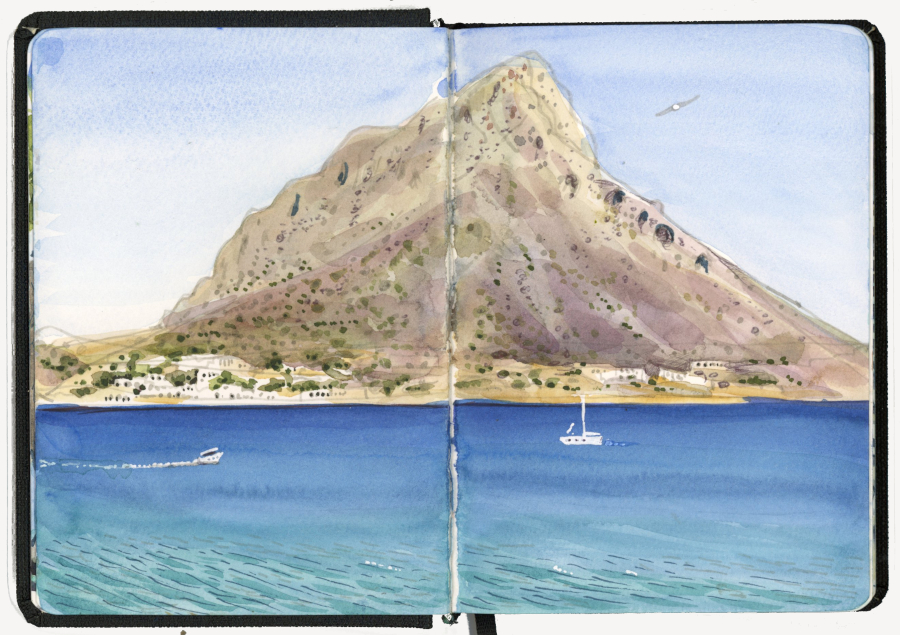
It’s hot, but the wind is strong, so having lunch outside is pleasant. Kalymnos is close to the coast of Turkey, and there’s an island lying just to the west, separated by a little bay. I draw the island, Telendos, from a little street café, trying to capture the look of the hazy island in the distance by using light grey ink and soft colours. The food is delicious. My favourite this week is grilled halloumi pita with lots of salad.
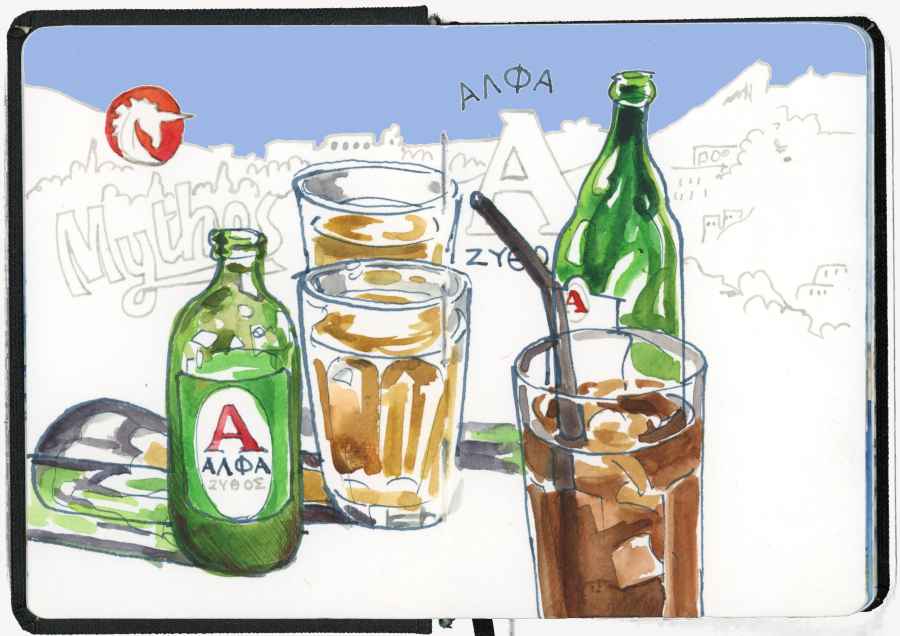
I draw the glasses and bottles on the table as we wait to be served lunch. I show Paddy and Olivia how to capture the green light of the glass as the sun shines through the beer bottle. They discover how effective the technique is and do the same with their sketches.
In the evening, I sketch the island again from the rooftop bar of our hotel…Liv draws it with the setting sun behind it and her sketch is beautiful.
Monday 10th August
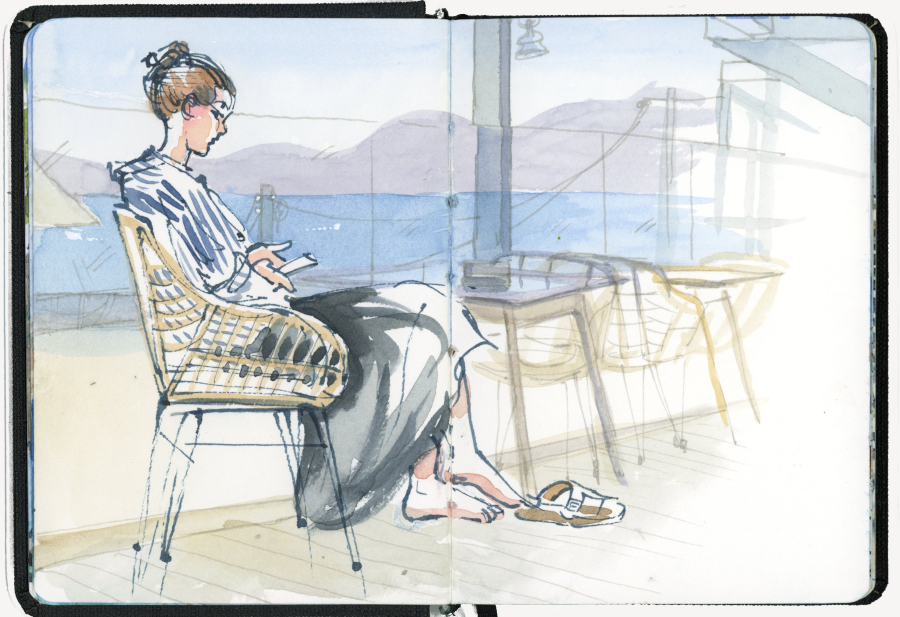
I sketch Olivia from the rooftop bar. You can see Telendos peeking out from the left hand side, and the northern hills of Kalymnos in the distance. It is the first time I have used the technique of painting the skirt between the rattan canes of the chair, and it won’t be the last.
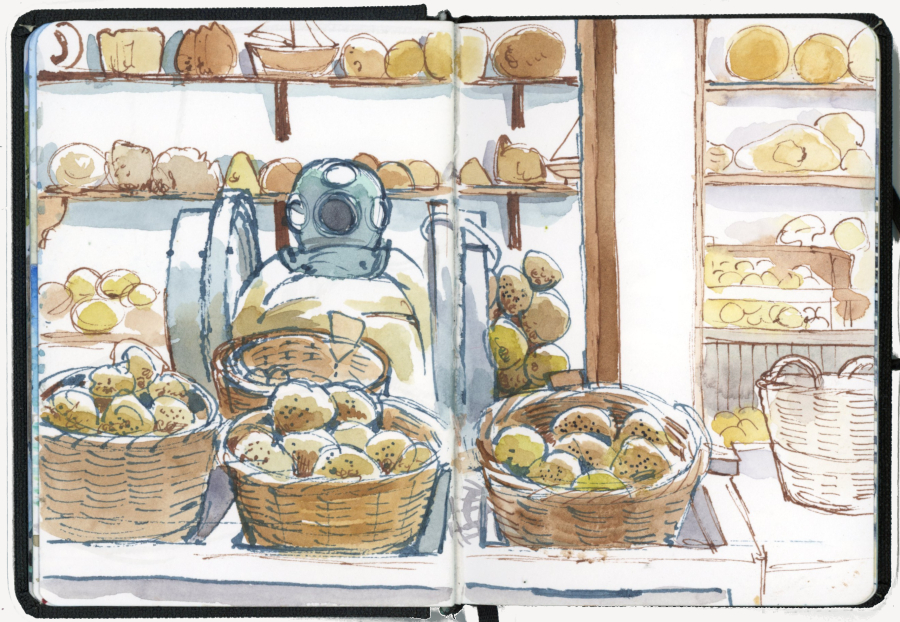
There’s a shop selling sponges near our hotel. In the light of the street lamps, it looks lovely – so tastefully laid out, and the colours are so soft – sponges of gold and brown that smell wonderful. Such pretty little animals (in life). We buy one or two, and the proprietor, another Nikolaos, seems touched by my sketch, and gives me a gift of a sponge.
The sponge shops often have a stuffed diving suit looking sightlessly through its little glass window, and I find them forlorn. But the shop makes a beautiful subject. I hear a little clicking noise as I sketch, and I think the proprietor and his son are playing a board game outside on the terrace, in the dark. No: Papa is using a shears to snip fibres from the sponges, I assume to round and neaten them.
Over the week, I am curious as to why there are so many Australian accents in Kalymnos. It turns out that people from Kalymnos went to Darwin in their number in the 1950s, because after the war no one wanted to employ Japanese fishermen for the pearl diving industry, and it was felt that Kalymniots would be good at that sort of thing, given their experience as sponge divers. It turned out they weren’t suited for the rough, murky waters off the coast of Australia, and they turned to construction instead. They stayed there, and prospered, and a few of them have bought restaurants and so on back in the old country.
Tuesday 11th August
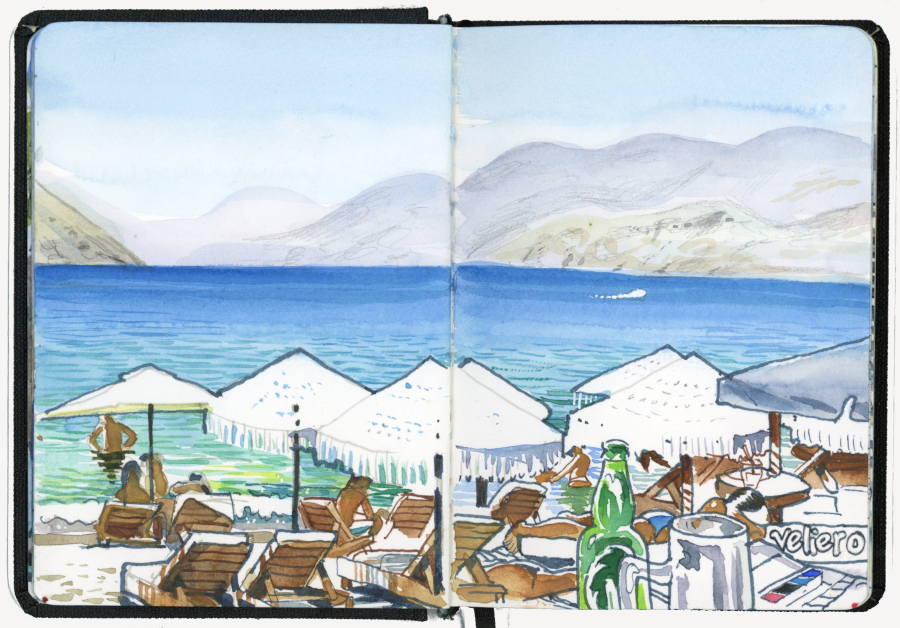
I sketch the beach from under the awning of a bar. Liv is sitting to my left, drawing a young woman sunbathing, but the young woman keeps shifting positions and Liv roundly curses her unwitting subject under breath. I tell her to get used to it – that’s the way it goes, sketching people in the wild, and I share a few tips (basically, speed it up).
Wednesday 12th August
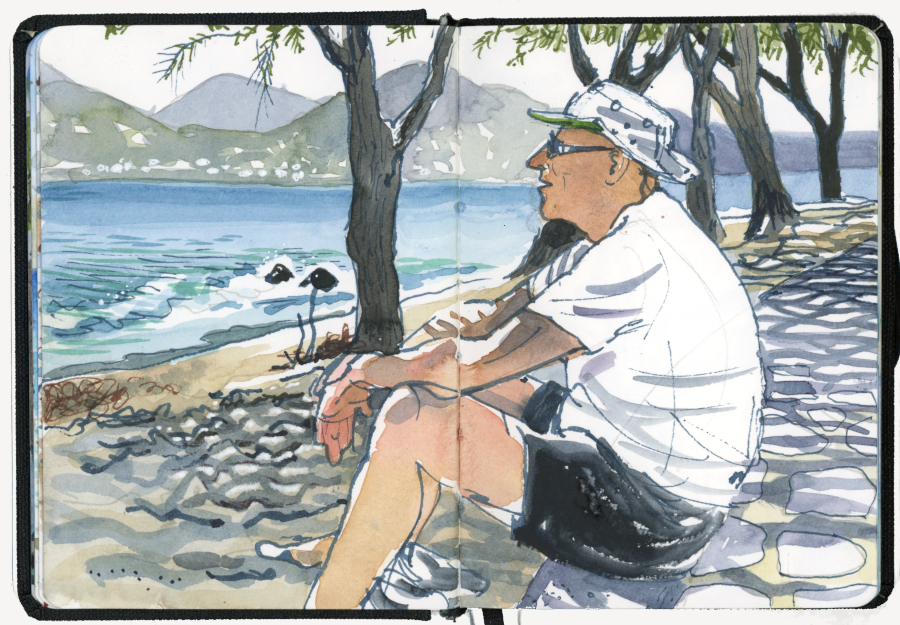
We catch a tiny fishing boat to Telendos, and I sketch Marcel sitting in the dappled shade of the trees on the water’s edge. The island is almost deserted, and its mountain rises straight up from the water’s edge. Everywhere there are signs warning climbers that “Telendos is not for beginners!” Both Kalymnos and Telendos are big attractions for the international climbing community. A server in a taverna on Telendos tells us she watches climbers on the side of the mountain across the bay from her restaurant, and has seen them lose their lives. Neither island is for beginners.
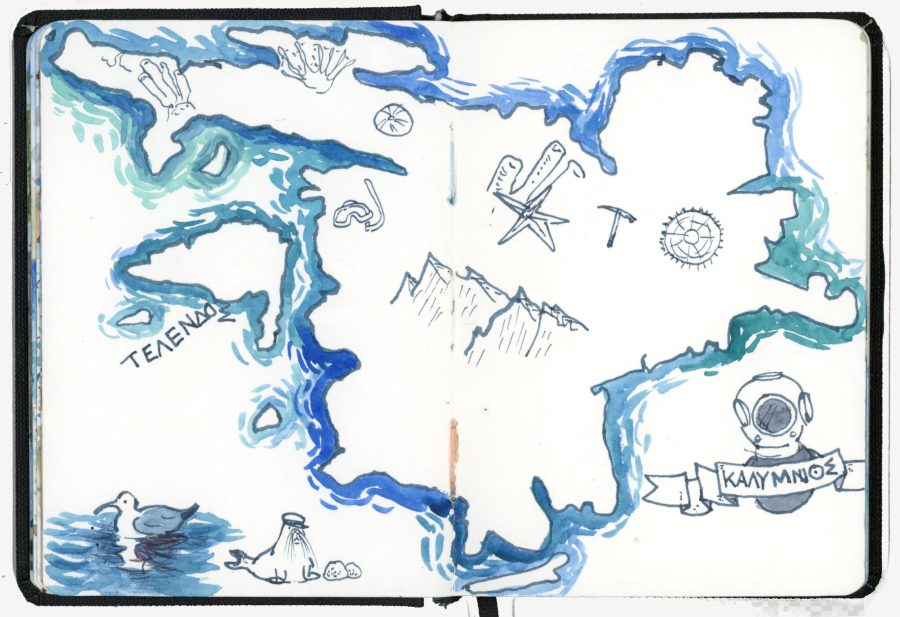
Then we go for lunch of red snapper and more beer in a tiny waterside village of blue and white and colourful flowers. I draw a map of the island on the tablecloth. I’ve written the names Kalymnos and Telendos in Greek because the alphabet is beautiful. At the bottom, I add a seal in a Greek fisherman’s cap…will he make his way into my serialised comic story? Perhaps, perhaps not.
Thursday 13th August
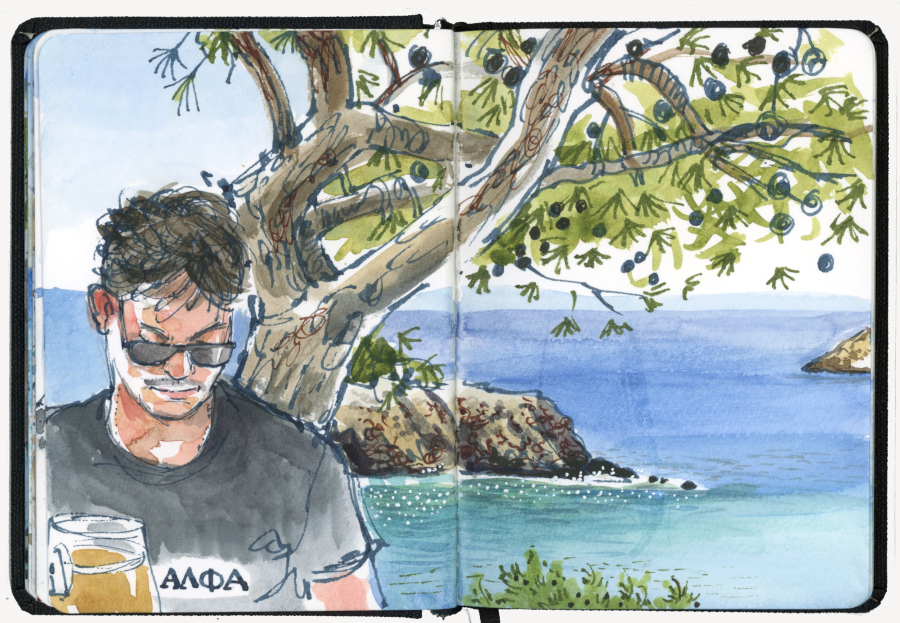
I draw Paddy sitting under the same tree I drew at the start of the week. He is a great subject – he understands the assignment, and doesn’t move. It’s really lovely in the shade of the tree. We watch dolphins frolic in the water far beneath us at the base of the mountain.
We settle up for our stay at the hotel. The owner has turned up. He tells us that Greece is extremely old-fashioned in terms of communications and that they barely use email for matters of an official nature. (This may or may not be true.) When we ask him how the second taxi driver had found out whose territory we were so fast, he says “you can be sure it wasn’t in the taxi drivers’ WhatsApp group.”
He tells us that there is a sunken city just under the surface of the water in the bay between Kalymnos and Telendos. He explains that the two islands were connected until an earthquake in 5 AD, and that you can snorkel over the sunken city just beneath you. I like to imagine the dolphins swimming in and out of Grecian archways, windows and doorways, in limpid, turquoise water. We are sorry not to have learned about this until now, when we are leaving the next day.
Friday 14th August
We catch a ferry back to Kos. We are on the 9.00am sailing, and sitting on board at 8.40am I realise I just have time to capture the sparkle on the water. THIS is why I am NEVER without my SketchPocket. The boat pulls away from the quay at 9.00am and I am done, the sketch drying in the hot morning sun.
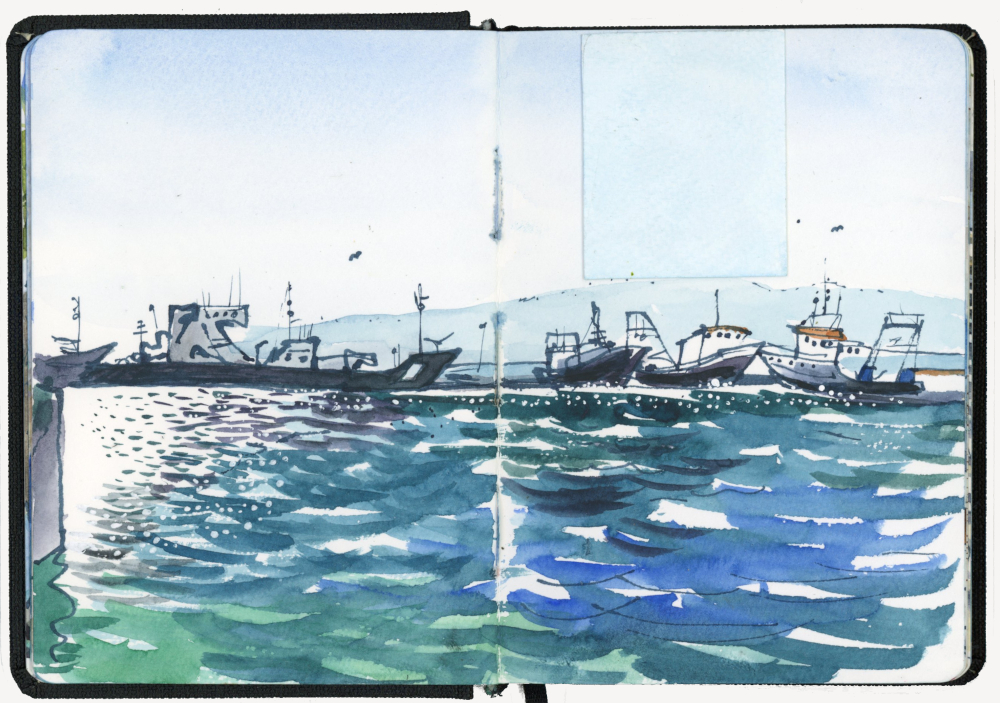
The little square on the right is covering an earlier, failed sketch of Paddy I started on the while Olivia was trying to capture the sunbather…he did NOT understand the assignment that day, and did not keep at all still.
We end up at the same taverna we started the holiday in: Paddy isn’t feeling well, and the same waiter from that first morning on our way to catch the ferry to Kalymnos is there, and we are at the same table – and I finish the sketch I started the first time we were there. The waiter is concerned about Paddy, and could not be kinder; he tells him he’s to stop drinking coffee, and on his own initiative brings him a bottle of cold water and a cup of chamomile tea, which is on the house. He gets his wife out of the kitchen to phone the doctor, translating for her as I tell him what’s wrong. We spend the day in hospital in Kos town, and Paddy turns out to be fine, which is great as we are on a flight later that evening. Later, we end up in the same taverna yet again, as we’ve hired a car from a place beside it, and must return the car (cash only, no insurance details taken, no paperwork whatsoever). The waiter puts his hand on Paddy’s shoulder. “Are you alright now, my brother?”
I am so proud of my two younger kids and their sketching. Both Olivia and Paddy sketch lots of subjects, and are delighted with their efforts. I present their sketchbooks to my students after class one day, which is one of the lovely things you can do with Zoom.
Join us – just €12.50 per month, with the option of extra classes for beginners for those who would like them (the latter by donation, as it gets complicated setting up more categories on my website). Taking up sketching from life is the single biggest thing I have done for my mental health: what started as a sort of focus-training to take my mind off my troubles has become something much deeper than that, and I consider myself cured now. Even today I can pull myself out of the doldrums just by opening my SketchPocket, pulling out my sketchbook and pen, and doing my best to solve the sketching challenge that lies in front of me.
You will love it!